


What if accidents didn’t have a chance to happen at all? Picture a worksite where workflows are engineered to prevent danger before it appears – where buildings, machines, circuits, and processes are designed with safety built at every step.
As Industry 4.0 reshapes engineering into a more hybrid practice, safety too must evolve with it. Driven by smart materials and interconnected systems, engineers can now anticipate risks earlier and address them at the source. This shift elevates safety from a basic requirement to a core engineering priority. This enables more efficient and resilient worksites through interdisciplinary problem-solving. This article examines engineering safety over time, how it is applied today with emerging technologies and hybrid approaches, its role across disciplines, and possible directions for the future.
Safety Then
Before exploring how safety has evolved with Industry 4.0, it is helpful to look at how it was traditionally managed. Understanding these earlier practices highlights the shift from reactive measures to more integrated and proactive approaches, and it shows why these changes matter for you, your worksite, and the decisions you make on every project.
Traditional engineering safety can be understood through several defining characteristics that shaped how risks were identified and managed across worksites:
Post-Design Focused
On construction sites, safety measures such as guardrails on elevated platforms, scaffolding reinforcements, and machine safety covers were often installed only after a near-miss or accident occurred. Traditionally, safety tended to address hazards after they became apparent rather than anticipating them. In many cases, hazards became clearer during actual site operations. While this helped improve safety where needed, it also meant that some risks were addressed as they were identified over time.
Compliance-Centered
Across engineering worksites, safety was guided by established standards and inspection routines. Engineers and teams followed detailed checklists and procedures to ensure requirements were met. In many cases, these standards provided a clear and consistent approach to managing known risks. While this supported structured and reliable safety practices, it also meant that responses were often aligned with existing guidelines, with less emphasis on identifying evolving hazards beyond them.
Isolated and Manually Managed Systems
On worksites, safety responsibilities were often handled within individual teams, with each discipline managing its own protocols and inspections. Mechanical, civil, or electrical teams conducted regular checks within their scope that relied on manual monitoring. In many cases, this ensured focused oversight within each area. While this approach maintained accountability, it also meant that information was not always shared across teams, so some risks across interconnected systems were identified gradually over time.
These practices laid out the groundwork for today’s safety systems and reflected the experience and judgment of engineering professionals working with limited technological support.
The Role of Safety in Industry 4.0
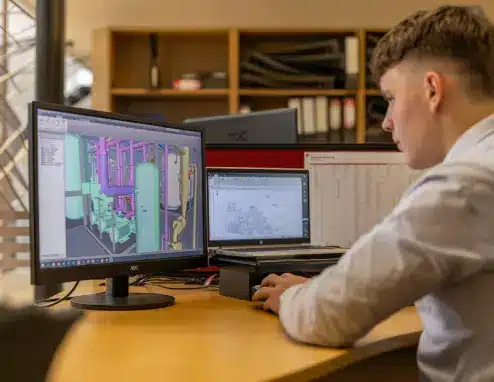
Safety in engineering has shifted from reactive measures to proactive, technology-driven approaches. Smart systems and real-time monitoring now allow hazards to be identified and managed before they become problems.
Proactive
Safety measures in construction sites are now considered during the planning and design stages, rather than added after incidents occur. Hazards can be anticipated before operations begin, which allow risks to be addressed early. In many cases, digital tools such as BIM, digital twins, sensors, and predictive analytics enable engineering professionals to simulate operating conditions, identify potential failure points, and evaluate risk scenarios before construction or operation starts.
This improves overall safety, allows resources to be allocated more efficiently, and prevents problems such as equipment malfunctions and structural failures before they arise, but can rely heavily on accurate assumptions that can lead to errors. Teams can anticipate risks early by continuously updating models with real-time feedback from these sensors. However, these systems rely on accurate assumptions and data quality, which means models must be continuously updated using real-time sensor feedback to remain reliable.
Adaptive
Safety practices still follow established standards and inspections, but they are now combined with real-time monitoring and adaptive measures. Teams can adjust protocols as conditions change that address evolving risks while maintaining regulatory compliance. In many cases, sensors such as vibration monitors, environmental detectors, and automated inspection tools provide continuous feedback to engineers. This strengthens adherence to safety standards and improves overall protection. However, evolving risks in adaptive systems may be overlooked if data is not properly managed. This can be addressed by implementing automated alerts and regular reviews of sensor data to ensure that safety measures adjust promptly to changing conditions while maintaining compliance.
Interconnected

Safety responsibilities are now coordinated across teams and disciplines through automated monitoring and applying control strategies that help maintain industrial stability. Mechanical, civil, and electrical teams can access shared dashboards that display real-time data from sensors that allow hazards to be identified collectively. In many cases, digital tracking systems, such as IoT-enabled equipment sensors and RFID-based material tracking provide instant feedback to all teams that enable interdisciplinary problem-solving to improve safety and optimize worksite operations. However, if one system fails or data is miscommunicated, it can affect all teams and compromise overall safety. To address this, shared dashboards and cross-verification of sensor data can help ensure that teams receive consistent information for coordinated decision-making.
Adapting Safety Now
Adapting safety now ensures projects run smoothly while keeping people and equipment protected. EIT students who take Safety, Risk, and Reliability courses gain practical, future-ready skills to work effectively in hybrid, technology-driven environments. With these skills, integrating safety into every project becomes a conscious responsibility that safeguards people and strengthens your engineering practice.
References
Why is Safety Important in the Workplace
Building Safer Worksites: Turning Safety from a Rule into a Reflex